What I've Learned
My personal journey started a few years back, just doing things blindly based on “information” I had picked up. I didn’t know much, and even what I thought I knew, I didn’t really understand. It took time, months, years, a lot of reading, researching and validating with so called ‘experts’ in the field. I’m still learning, I’m still applying, and I’m still trying to figure it out. At first, I would follow someone who said ‘eat this and you’ll lose x lbs in 1 month’, or ‘do these exercises and you’ll look like this in no time’. These ‘get rich quick’ scheme version of a healthy lifestyle, don’t work. Mind you, it may have worked for them, but what I learned, is that what may work for someone else, their body, won’t necessarily work for you, and your body. This is a process. You’ll have to try a few different things, wait a few months to see results (or not), and adjust accordingly. Keep what works, change what doesn’t. Find what works for your body. Each body is different, age, gender, ethnicity, environment, metabolism, culture, family dynamics, and the list goes on. For now, I thought the best thing to do is first put it all together, write it down somewhere and build on it. This is a journey, a process, I don’t ever expect to know it all, to be perfect. I just expect to keep learning, keep improving.
Help me if I am missing something, need correcting, or straight out wrong. I will keep this up to date, to help myself, to help you, and hopefully, one day, help my kids. Feel free to reach out to me and Let’s Connect.
Nutrition
I can’t over emphasize the importance of nutrition in your fitness journey to better health. Exercise and nutrition go hand in hand. It’s not just how much you eat, but also what you eat. You can eat salads all day long and gain weight, or eat junk all day long and lose weight. How can that be you ask? Well, let me break it down for you into two categories, quality and quantity. Quality is what you eat, which will effect your health, your organs, your heart. Quantity is how much you eat, which will effect your weight. Eat more food (calories) than you burn (exercise) will result in weight gain. Burn more calories than you eat, will result in weight loss. However, there is more to the scale weight than you think. That’s where, what you eat, is important. I can weight 160 lbs and be all fat, or I can be 160 lbs and be all muscle. So I can eat junk all day, and exercise all day to burn it off, but I won’t be healthy. Same with eating salads all day and just sitting on the couch with no exercise, I still won’t be healthy. Eating salads on their own doesn’t make you healthy and neither does just exercise on its’ own. Get it now? Eat foods that help your body, organs and heart, and exercise to build muscle and reduce body fat. To break it down even further, don’t focus solely on scale weight, as losing weight and losing fat are two different things. You can gain weight as a result of building muscle (a good thing) and not necessarily mean you’re gaining fat, but you can also lose weight as a result of breaking down muscle (which is not a good thing) and not necessarily losing fat. Get yourself a smart scale and breakdown what your weight consists of. Focus on decreasing body fat %, subcutaneous fat, visceral fat, and increasing muscle mass.
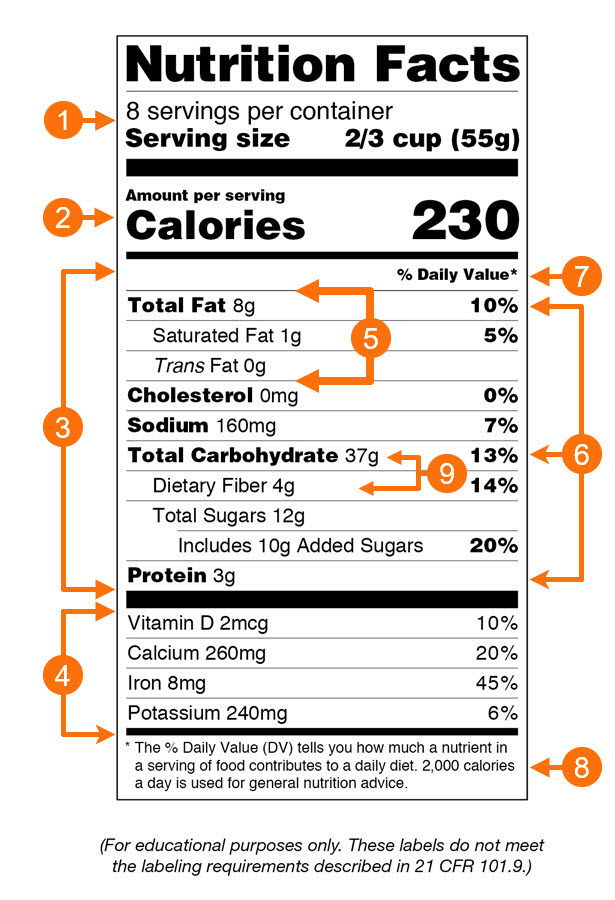

Not all nutritional panels will show the number of servings per container and that’s okay. The key information here is the serving size. This is what all the values below are in relation to. You may have to do some math to determine your total caloric intake based on the serving size and how much you actually consume. For example, if this was Greek yogurt, and you had 2 cups, then your total caloric intake is 690 (there are 3 x (2/3) cups in 2 cups). That also means, that you had 24g of fat (3x8g), 99g of carbs (3x33g) and 9g of protein (3x3g). Why 33g of card you ask? Well, see below #9 for explanation.

This is the number of calories per serving, but It is important to note, what makes up these calories, and that is Fat, Carbs and Protein. Fat accounts for 9 calories per gram, while carbs and protein account for 4 calories per gram. Many people will count macros and not look at just the number of calories. Depending on your fitness goals and daily diet, it is important to consume the right amount of each. For example, if you are someone who is looking to build muscle, then you want to ensure your total daily caloric intake is consumed mostly by protein and carbs. Also, if you’re trying to stay in a calorie deficit, then avoiding foods high in fat will help ensure you can eat more.

This section contains your macro nutrients. It is important to understand the details of what you are consuming. Sodium is salt and over the day, you want to ensure you limit your intake. Cholesterol needed by your body is produced by body, so you don’t really any additional. Do note that there are two different types of cholesterol, LDL and HDL, the latter being good for you and the former, not so good. To decrease LDL levels and increase HDL levels, focus on your Fat intake, see #5 below for more details. Carbs are another macro people try to avoid, but you need carbs for energy and is used by your muscles to power your workouts, see #9 below for more details.

These are micronutrients, which are simply your vitamins and minerals. It’s important to get as much of these as possible. They each have their own health benefits and ensuring to have a nutrient dense meal will help maintain steady blood sugar levels, and healthy organs.

Fat is an important component to watch out for. It contributes 9 calories per gram and can easily make or break your daily caloric targets. However, more importantly than that, you want to ensure you consume the right fats, the ‘good’ fats and limit the ‘not so good’ fats. Avoid foods high in saturated fat, trans fats & added sugars, and instead opt for unsaturated fats. Saturated fats can come from meat, oils, dairy products, processed meats and pre-packaged snacks and desserts. Too much saturated fats can lead to high LDL cholesterol levels and increase risk for heart disease. Unsaturated fats are also broken down as Monosaturated and Polyunsaturated fats, which are good for your heart and essential to your health. These reduce the harmful LDL levels and increase HDL levels. Unsaturated fats can be found in seeds & nuts, plant oils, fist, olives and avocados (amongst many other products). It is important to have the right amount of saturated and unsaturated fats in your diet, as they are necessary for good health. Not all saturated fats and LDL are considered ‘not good’. The source of these fats are just as important. The key here is, limit processed foods.

Fat, Carbohydrates and Protein are the three main macros people will focus on. Based on your fitness or health goals, you will want to ensure your total daily caloric targets is comprised of a ratio based on these three. For example, a high protein diet will make up 36% of your daily caloric target, carbs with 34% and fat 30%. If your daily caloric target is 1800 calories, then take 1800 * 36% = 648. Then divide by 4 (remember protein and carbs make up 4 calories per gram) is 162 grams of protein. That makes carbs, 153 grams and fat, 60 grams. In order to determine your daily caloric target, you need to first find out what you are currently burning in a day. Take your BMR and current activity level, then add or subtract ~500 calories. Add if you want to gain weight and subtract if you want to reduce weight. What is BMR and why 500 calories? BMR is short for Basal Metabolic Rate, the amount of calories you burn in a day by just living, doing regular day to day activities. Add the calories you burn as a result of additional work, working out, walking, running or any activity that does not constitute as normal day to day activity, and that is your daily caloric expenditure. +/- 500 calories per day will result in losing or gaining 1 lb per week. They say about ~3500 calories equals 1 lb, so divide that by 7 (days a week) and that’s where you get the 500 calories from. Of course every body/person is different and so take that 3500 calories as a guideline and increase/decrease based on learning from your body. Do what is sustainable and manageable, for the long run, not the short term. If you focus on life changes, then you will succeed. Focus on short term goals, then in the long run, you will fail.

The % Daily Value (or %DV) is a quick reference to tell you if a food product contains a little or a lot of a certain nutrient:
- 5% or less is a little
- 15% or more is a lot

This is a footnote, usually standard text. The problem with this footnote is the reference to 2000 calories per day. This has not changed in decades and as I explained in point #6, every body/person is different and you need to determine your daily caloric expenditure and adjust accordingly to your fitness and health goals. Don’t assume you burn 2000 calories a day, chances are, you don’t. This number does not take into account, age, gender, weight, ethnicity, environmental conditions, stress, sleep, and there’s so much more. Guess what, it will also change over time, as you change, your weight changes, your life changes. Do yourself a favour and get a smart scale, something that reports your BMR, then separately track the calories burned as a result of physical activity and use actual numbers, in order to be successful in achieving your goals.

Similar to fat, there are different types of carbs, simple and complex. Complex carbs are packed with nutrients, starches, fiber and as a result, won’t spike your blood sugar levels. This is because the body digests it more slowly, releasing glucose into the bloods stream gradually. Simple carbs, which sometimes are also referred to as empty calories, are just foods that have little to no nutrients. These could be processed foods (like white bread, white rice), junk food (like chips, chocolates, candies, baked goods, etc). They key is not to avoid simple carbs, but rather limiting them and ensuring you take in more whole foods. Simple carbs are great for instant energy. If your going for a run or a long bike ride, you’ll need this burst of energy. However, if you do want to have a sugary item and don’t want the instant sugar rush, then you can pair it with a fat, protein or another whole carb with fibers, as these will also help reduce digestion. Fiber is an important part of your diet, as it helps slow down digestion, makes you feel fuller, for longer, and most importantly, it passed right through your body. That’s why why in point #1, the total cabs consumed by the body is actually 33g. You reduce the amount of fiber from the total amount of carbs, this is also referred to as ‘Net Carbs’.
Physical
Activity
Nutrition is only half the battle. Incorporating any form of physical activity is just as important. Moving your body, elevating your heart, doing things that are hard, lifting weights, sweating, being out of breath, challenging yourself, it’s all part of the process. You can’t make progress if you don’t move. The only type of ‘failure’, is in failing to try. Giving up before you even start. So move. Find something you enjoy, something you can stick to. Start with something small, then build on it. Many people go all out, but that is not sustainable and they will soon over exert themselves and quit, saying ‘its too hard’, ‘I can’t do this’. Remember, the goal here is changes that you can incorporate in your daily life, for the rest of your life. If you want to set your self up for success, then have a plan. If you’ve never worked out, done any type of fitness activity, then don’t just jump into the deep end and do everything. Take it a step at a time. Start with walking, a few weeks later, increase the speed, increase the time, increase your heart rate. Another few weeks later, add in some 15-20 min warmup exercises. Then a few weeks later, add in some cardio, then weights, and so on and so on. Incremental changes over time will have a big impact. Many people don’t succeed because they want instant change, and that’s not what this is about. This is about the long game. It didn’t take you months to get to where you are, so don’t expect it will take months to get to where you want to be. Set a realistic timeline, 1 year, 2 year, etc, be patient with the process and watch yourself over time change, become stronger, become healthier. Tracking your progress is also important to stay motivated, to show it’s working. As your body changes, you won’t necessarily see it, but if you take weekly pictures, measurements, and compare them over time, you’ll be impressed with what you can achieve. You won’t be motivated everyday, so don’t use it to get you moving, you just have to move. Have pictures or words defining your goals, your objective, and look at them to remind you why you are doing it, and just go do it. You’ll be glad at the end of the workout that you did. Many times (if not all the time), I turn into what I call ‘zombie mode’. I don’t let my mind know what my body is doing, and get my body to just get changed, make my way to the basement, and hit play. Before my mind catches up, or tries to find reasons, excuses not to work out, it’s too late. Sometimes I’ll listen to music to get me in the mood, or look at myself in the mirror and remind myself of why I’m doing, or look at other people and their progress. If you need support, someone to push you, or something to keep you accountable, then find it, use it. If I can help, all you have to do is reach out. Let’s Connect.
Walking is so underrated. I didn’t get it at first, but now, I walk all the time. Outside when possible, treadmill when I can’t. Even if I got a workout in, I will still aim to get in an hour walk. If I’m not working out that day ie rest day, I will 100% get a walk in. A 1 hour walk outdoors, at a decent pace, can easily burn up to 500 calories. I try to keep my pace at 10min/km. On a treadmill, I will do an incline, 6 or 7 and a speed of 3 mph. May not seem fast, but I sweat and I still burn around 500 calories.
One of the first things someone will tell you, is get 10,000 steps in. Why? Because it’s simple. Walking is one of the most easiest things you can do, incorporate in your day and doesn’t require any equipment or cost. A no excuse workout. The fact that your body is doing something different, doing some work, it will immediately have a positive effect, both physical and mental. Walking can be your gateway to better health, as you change things up and incrementally add to your daily routine. Also, walking has shown to have so many benefits, to your cardiovascular health, blood pressure, stress, mood, sleep, joints, and so much more. Just walk, even if for 1/2 hour, start somewhere, start here, start with walking.
When I wanted to loose weight, I started with running. I would run on the treadmill all the time. It helped me lose my first 20 lbs. If you can do it, that’s great. After a while, I stopped and focused on walking. Simple reason, I was getting old, running is hard on the joints, and I couldn’t sustain the run for long, breathing was becoming difficult and I was exhausted afterwards. Walking became my go to. The only main difference between walking and running, is that you’ll hit your calorie goal much fast with running. A 20 min run may equate to the same as an hour walk. People love incorporating a run as part of their HIIT workouts, and that’s great. I am not against running, it has it’s benefits and it’s difficulties. I did a 5k run for a fundraiser once, and I felt proud of what I had accomplished. Can’t do that now, but that’s okay. I’ve moved on and have become better. That’s the ultimate goal. Every step towards better health, matters, counts!
Lifting weights, weight training or resistance training, whatever you want to call it, is key to muscle growth and part of a healthy lifestyle. Losing weight (ie fat) is one thing, but building muscle is very important. First, 1lb of muscle is significantly smaller than 1lb of fat, so if your scale does not move but you’re burning fat and building muscle, that’s a good thing. You’ll notice physical changes in your body when you lose 1 lb of fat and replace it with 1 lb of muscle. Plus, having muscle on your body burns fat while at rest, which means your body is working out, even if you’re not. Many people focus on just cardio, just losing weight, and that’s fine, but if you really want to be strong and well balanced, then that means also incorporating some sort of weight training in your routine. You don’t need to buy crazy weights, or gym equipment, you can do exercises that use your body weight, or resistance bands. At some point, you can add weights when you’re ready and add the right weights.
Lifting weights, weight training or resistance training, whatever you want to call it, is key to muscle growth and part of a healthy lifestyle. Losing weight (ie fat) is one thing, but building muscle is very important. First, 1lb of muscle is significantly smaller than 1lb of fat, so if your scale does not move but you’re burning fat and building muscle, that’s a good thing. You’ll notice physical changes in your body when you lose 1 lb of fat and replace it with 1 lb of muscle. Plus, having muscle on your body burns fat while at rest, which means your body is working out, even if you’re not. Many people focus on just cardio, just losing weight, and that’s fine, but if you really want to be strong and well balanced, then that means also incorporating some sort of weight training in your routine. You don’t need to buy crazy weights, or gym equipment, you can do exercises that use your body weight, or resistance bands. At some point, you can add weights when you’re ready and add the right weights.